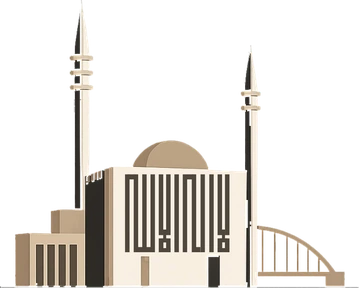

Islam
Submission to the will of the one God, and peace. What Islam means and the five pillars on which the faith rests.
What does Islam mean?
To understand Islam, it is important to know what the word means. Islam is Arabic and means submission or surrender to the will of the one true God: the only one who has the right to be worshipped. Someone who surrenders to the will of the one God is therefore called a Muslim. The word ‘Muslim’ means ‘obedient to God’, but it also means ‘peace-loving’.
Islam is not named after a person, as is the case with Christianity, named after Jesus Christ, Buddhism, named after Gautama Buddha, Confucianism, named after Confucius, or Marxism, named after Karl Marx. Nor is it named after a particular tribe, as Judaism is named after the tribe of Judah and Hinduism after the Hindus. For Islam was not invented by man, but was chosen by Allah Himself as the name for His religion.
Allah stated this clearly in His final revelation to mankind. In the last scripture of divine revelation, the Qur’an, Allah declares:
“This day I have perfected your religion for you, completed My favour upon you and chosen Islam as your religion.”
Surah 5, verse 3
The five pillars.
Faith in Islam rests on five pillars. These pillars are like the foundations of a house; remove one of them and the house collapses. To follow the right path in Islam and to be able to say ‘I am a Muslim’, it is therefore necessary not only to believe in the six articles of faith but also to fulfil all five pillars of Islam.
- 1
Shahada (declaration of faith)
Faith begins with the shahada, the declaration: “Ashadou an la ilaha illallah wa ashadou anna Muhammadan rasoulallah.” By saying this you bear witness that there is no god but Allah and that Muhammad is His servant and prophet. Merely pronouncing this declaration with the mouth has no value: one does not accept the declaration simply by saying it, but by believing with the heart that Allah is One and has no partners. One must also believe with the heart that Muhammad is His prophet. Before one can pronounce the shahada, one must first believe in the six articles of faith.
- 2
Salah (prayer)
Prayer is performed five times a day: before sunrise, at midday, in the afternoon, in the evening and at night. According to tradition, whoever performs their prayers in congregation at the mosque receives 27 times the reward of a prayer performed alone. With a clean body, clean clothes and in a clean place, you submit to your Lord with devotion, in remembrance and gratitude, asking for forgiveness. Verses of the Qur’an are recited with particular bodily movements, to purify body and mind and so remain in direct contact throughout the day with your Creator, Developer and Sustainer. Prayer makes you righteous, within and around you. Besides the five obligatory prayers spread over the day and night, there are the annual Eid prayers, the weekly Friday prayer and the daily voluntary prayers for all adult men and women. All these prayers consist of an obligatory and a voluntary part, whose elements you can easily learn and perform with a little effort. This is your lasting readiness to submit voluntarily to Allah’s commandments, for your own good and without any intermediary: you need no priest or monk to perform your prayers, for you are in direct and close contact with Allah.
- 3
Zakat (alms)
The third obligatory pillar is the alms (zakat), which touches on people’s economic well-being and spiritual growth. The net savings of every Muslim belong not only to him and his family, but also to the needy, the poor and six other socially vulnerable groups, as prescribed in the Qur’an. 2.5% is paid on net savings above a threshold, for cash, jewellery, shares and so on, over the year; it is settled in the month of Ramadan. Zakat purifies your wealth and helps establish economic balance and social security. Muslim states are obliged to collect and distribute zakat; elsewhere it is the duty of Muslims themselves to collect it during the year and distribute it among those entitled to it. Besides this obligatory payment, Allah encourages you to give to the needy and the poor from the generosity He has bestowed on you. According to the Qur’an, such charity (sadaqah) earns a reward of 700 times or more.
- 4
Sawm (fasting)
In the blessed month of Ramadan, fasting from dawn to sunset is obligatory for all Muslim men and women. During this month you abstain from food, drink and sexual relations, avoid idle talk and bad deeds, and devote yourself to prayer, reciting the Qur’an and good deeds. While fasting you must be pure in body and mind. This is the month of special blessings and forgiveness from Allah. In this month the first verse of the Holy Qur’an was revealed to the Prophet Muhammad. The Qur’an makes exceptions to fasting: the sick, travellers and women who are menstruating, pregnant or breastfeeding do not have to fast. Fasting is good for your health, a training for your spiritual growth, it strengthens the bond of brotherhood between all people and Muslims, and it is a complete physical and spiritual surrender to the will of Allah, for His pleasure and protection. At the end of the month of fasting, Muslims all over the world celebrate Eid al-Fitr with prayers and festivities.
- 5
Hajj (pilgrimage)
It is the duty of every Muslim who is adult, of sound mind and healthy in body to visit the Ka’bah and the blessed places around it once in their lifetime, during the pilgrimage season (the twelfth month of the Islamic calendar). For Muslims, the pilgrimage is a means of turning to Allah, asking forgiveness for all their sins and solemnly promising never again to do wrong. A visit to the holy places strengthens a person’s moral and religious feelings. Socially, the pilgrimage resembles an international congress, where people of different nationalities, colours and races come together. The acts of worship in Islam aim to shape the human being into a perfected being and to bring peace and order to society.
Welcome to our mosque.
Drop by for prayer, a lesson or a conversation. Everyone is welcome.